Home
Home Information
 Ministries
 Resources
 Contact Us
FIRST BAPTIST CHURCH OF BARBERVILLE
The History of The First Baptist
Church of Barberville
1869 - 2008
By: Rev. Warren Thomson -1979
Revised By: Rev. Jimmy Dean - 2008
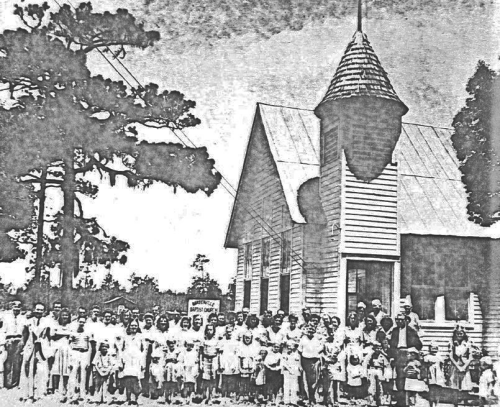
Homecoming
Table Of Contents
Dedication
Sources
The
Pioneer Days 1869-1889
Conditions
After the Civil War
Methodist-Episcopal
Lungren
Church
Joseph
Underhill Farm
Spring
Grove Records
Board
of Public Instruction
The
School House
Spring
Grove Baptist Church 1881-1887
1881
St. Johns Association
1885
Rev. D.W. Glisson
Personal
Letter from Alice Sherrill
1887
– 1889
The
Golden Age
1890
– The First Baptist Church
1891
April
18, 1892 – Ground Breaking
1893
– 1919 Chart
1917
– Seminole Association
Emporia
and Pierson Churches
Conclusion
Roll
Call of Pastors
Last
40 Years of History
The
History of The First Baptist
Church of Barberville
1869 - 2004
By: Rev. Warren Thomson -1979
Revised By: Rev. Jimmy Dean - 2008
Dedication
This Church History is dedicated to a group of men and women that has helped to shape the history of this wonderful church. Many of whom have met their Master face to face in Heaven. Others who are still working in the Master’s vineyard. To the Pastor’s who have given themselves to the furtherance of the Gospel and God’s Church.
They
have fought a good fight,
They have finished the course,
They have kept the faith,
There is laid up for them a crown of righteousness,
Which the Lord, the righteous judge, shall give them on that day.
(Adaptation of 2 Tim. 4:7-8)
This history, of the First Baptist Church of Barberville, is an attempt to gather verifiable records on the oldest Baptist church in Volusia County, Florida. Because of the time, space, and incomplete research, much of the unrecorded history contained within family records and in the hearts and minds of many people will go untold. It is hoped that someone in later years will build on and expand this history to preserve the heritage of a great pioneer church. Because of lost church records, the writer was hampered in his attempt to compile a more complete history.
The records used
in this history come from the following documented sources:
Ø Volusia County School Board Minutes
Ø St. Johns River Association Minutes
Ø Seminole Baptist Association Minutes
Ø Histories of Florida Baptist, Volusia
County
Ø Histories of Florida Baptist, Town of
Volusia
In addition to these documented materials, personal interviews with community historians and other people contributed greatly to this history. To cover 130 years is a large task. The history will be divided into the chronological time periods of the life of the church.
The
Pioneer Days
1869 – 1889
Conditions were difficult after the war, and Volusia County, as well as other counties experienced spiritual and economic poverty, with a shortage of churches and ministers.[3] In 1871 John Milton Hawks, a resident and superintendent of public instruction in Volusia County, said “the public schools are not yet in operation; we have no politicians; we have no jail and little need of one; no clergymen resides within our borders”.[4] Because of this lack of ministers, many of our early pastors traveled great distances to preach. These conditions can help to better understand the beginning of the First Baptist Church of Barberville.
To determine with certainty the exact time and circumstances when the First Baptist Church of Barberville was originally founded in not possible at present. This year of 2008, the church will celebrate its 139th birthday which assumes it was founded in 1869. This date is based on the writer’s examination of evidence which follows. The evidence suggests several possibilities of how the church was started.
The first possibility of the origin of our church centers around the Lungren area. Dr. Henry Lungren, a Volusia physician, and his wife lived mid-way between Barberville and Volusia. In 1866 Dr. Lungren was listed as a resident of Volusia but later must have moved to the area called “Lungren” that bears his name.7 Barney Dillard Sr. (1864-1962) remembers Dr. Lungren telling him about a preacher:
“In 1868, there came a preacher named Vassar, he called himself Uncle John. Dr. Lungren told me Uncle John was sent down here to preach to the colored freedmen between them. I don’t know how much he preached, however he sold me some books and I thank him for that.”8
There are some problems with the date “1868” and the interpretation of this letter. It is a great possibility that the words “between them” can be taken to mean there was a white congregation at Lungren as well as a black one. The need for ministers to preach to both, black and white was great.
The second possible source of our early church is the Joseph Underhill farm east of Lake Winona. Schene reports on a Homestead Entry Claim and says:
“Near the east-side of Lake Winona, Joseph Underhill, subsequently a county commissioner, settled on a 160 acre farm in 1868. Unlike his neighbors, though, Underhill spent his first months erecting a church and then cleared 5 acres. Within 2 years he had cleared an additional 15 acres and was cultivating a variety of farm products.”9
Underhill probably erected this church for his family, workers and pioneers who lived nearby. No one knows how long this church continued, but it was possibly assimilated into our early church.
Having discussed two possibilities of how the original church was created, let us look at how they may be related in the founding of the First Baptist Church of Barberville. First, the Lungren Church was closer to where our early members lived and worked. One example is O.J. Dillard who was an early member of the “Spring Grove Baptist Church”. “After Astor built a railroad to the west bank of the river, O.J. Dillard , and wife Carolyn, moved to the farm in Lungren to grow produce, cotton and oranges there”.10 The Lungren church was a central location for our early members. Several years later, it was decided to relocate in order to be in a more central location for members in the West Pierson area. Secondly, Thomas Underhill, the son of Joseph, was also a member of the early Spring Grove Baptist Church, which is evidence to suggest that Underhill’s church at Lake Winona was assimilated into this early church at Spring Grove. From these possibilities, the Spring Grove Baptist Church, which later moved to Barberville could have been founded in 1869.
In the fourth annual session of the St. Johns River Baptist Association, October 15 – 17, 1881, the Spring Grove Baptist Church was accepted for membership. This is the first clear evidence of our early church. The minutes of the association on October 15, 1881 read as follows:
“Petitionary letters were called for; and the following presented letters, viz; Spring Grove, Volusia County; and the Como Church, Putnam County which were received and the right hand of fellowship given by the moderator, and the deligates of said churches took their seats as members of this body, viz… Spring Grove, Peter Stone.”11
The St. Johns Association, a group of churches in the Palatka area, was organized in 1877, just four years previous to our admittance. Including the three churches admitted in 1881, the association had 18 churches with a total membership of 462. The Spring Grove Baptist Church had a membership of 17 people.12 The link between this church and the First Baptist Church of Barberville (1890) can be seen in its membership. The same key people were members of both churches.
From this reference of our church in 1881 let us go back in time and speculate on the 12 years of virtual silence, from 1869 –1881. Our church was active during this time, but due to the circumstances of various meeting houses and the lack of ministers, no records exist to tell us of their activity. Was our church a member of any other association before 1881? Probably not. The Alachua association, which did not include the eastern or western banks of the St. Johns River, had been formed as early as 1847.13 This association was the closest one to us. The St. Johns Association had not organized until 1877.14 Our church could have been active and not have been a member of any association. In view of the lack of clear evidence to the contrary, this is a safe conclusion.
If we were not a member of any association between 1869 and 1881, that does not mean we did not have fellowship with other churches. Dr. Earl Joiner says associational growth was a feature of Florida Baptist after the Civil War.
The early churches at Lungren and Lake Winona probably came together into one church at Spring Grove in 1869 which is our founding date. Use of the word “churches” refers to the members that composed them. People like O.J. Dillard and Thomas Underhill, who may have been associated with the Lungren and Lake Winona church, respectively, were also listed as members of the Spring Grove Baptist Church. Yes, it is believed that the early Baptist settlers had a Baptist Church during these years even though its exact location in uncertain.
Some indirect information about the Spring Grove Baptist Church, during this time before 1881, can be drawn from information on the Spring Grove School. Our church in those days met in the facilities used by the school. The minutes of the Board of Public Instruction for the County of Volusia meeting in Enterprise, Florida, January 1877, gives us the first record of Spring Grove School.
The following list gives the number of the school, the location, and the amount apportioned each; No.1 Volusia $60.00, No. 2 Deep Creek $ 60.00,
No. 3 Spring Grove $ 81.00. We also read that the expense in erecting School houses, which in every district has been borne by the patrons and the sparsely condition of the district prevents them from contributing to the salary of the teacher after the expense attending the erection of a School House. 15So then, there was a school at Spring Grove which had been constructed and financed by its patrons.
However, later records reveal that the school had been started prior to 1877 but that no permanent School House had been erected yet. The church and the school probably were using a brush arbor, with log sides and a brush roof. In the following years 1878 -1881, the school was allocated $147.50; $188.10; $129.50 and $233.10 to meet its expenses. The records of November 8, 1881, show that Frances D. Harper, Wm. Purdom and Peter Stone were appointed trustees of Spring Grove, No. 3. 15 These names probably reflect back to the early patrons in 1877, that built the school. These same men were members of the Spring Grove Baptist Church according to the earliest record of our church in the St. Johns Association. In all probability, they were members long before this. If they were the patrons and later the trustees of the school and members of the church, the use of the arbor would have fallen naturally to the use of the church. This brings us to the date 1881, when our church was first admitted into the St. Johns Association and its earliest specific historical information.
The Centennial History of Volusia County (1854 -1954) says that there was a Baptist Church at Spring Grove, a point between Barberville and Astor.16 More precisely this point was about 100 feet North of Troy Peterson’s present day home. This historic site is now graced with a hammock fernery. The school and church derived its name from a nearby spring several hundred yards west of the Peterson home. The spring flowed as clear as glass until the 1960’s when county road crews covered it up while doing work on the ditches.17 Mrs. Odetta Coleman remembers her mothers story about the spring. She Eliza Minshew Lemon , told me about her walks to the church over dusty roads and that before she got there she would take off her shoes and wash her feet in the spring.18
The church and school did last several more years. The church has records in the St. John’s Association from 1881 to 1887. School Board records show the school receiving $ 225.00 in September of 1886 for the 86-87 school year. F.D. Harper was still listed as the school’s trustee.19 These two dates are in agreement that the Spring Grove Baptist Church and school lasted until 1887. Eventually a wooden house replaced the early brush arbor. Local residents remember hearing about the house before it was destroyed.20
Spring
Grove Baptist Church 1881-1887
1881 - When we joined the St. Johns Association, Rev. B.W. Becks was our pastor. During the same meeting that we entered the association, Mr. Becks was unanimously elected as Moderator of the Association. He lived in Palatka and pastored Osceola Church at Picolata, Para Church at Putnam Hall as well as the Spring Grove Church.21 He probably traveled to our church by steamboat. Rev. Becks also served as the chairman of the Mission Board22 and represented the association at the Florida Baptist State Convention in December of 1881, at Ocala.23 Being active in associational missions, Rev. Becks led the church to give toward its support. In 1881, the Spring Grove Church contributed $ 1.00 to support the work of the association.
One of the early leaders of the church was Thomas Underhill. He served as Church Clerk in 1881, and was a deacon in the church. Another church leader was Pete Stone, who was our delegate that represented the wish of our church to unite with the St. Johns Association. In 1881, the church baptized 1 precious soul and had 17 members.24
1882 - We are listed as not having a regular pastor. Thomas Underhill continued as the Church Clerk. We were represented at the associational meeting by letter, which means that we sent in the statistics of our church. We declined slightly in membership, from 17 to 15, but we increased our associational giving from $ 1.00 to $ 1.75. O.J. Dillard, possibly church treasurer, gave $ 1.00 for Theological Seminary causes and a total of $ 6.00 for the year was attributed to Spring Grove for State Missions. Even the Sunday School, named Emporia, contributed $ 2.30 for mission causes.25
1883-1884 During these years, no records are available for the churches of the St. Johns Association. In 1885, D. W. Glisson was our pastor and it is possible he could have been pastor during 1883-84 as well. The only records we have of the church during these years, is about their generous mission giving. During the last quarter of 1882 and the first quarter of 1883, Spring Grove, (O. J. Dillard, treasurer) sent in a total of $ 6.00 for State Missions.26 At the time this was a sizable amount for any church. In addition, the church is credited for their gift of $ 1.00 to Foreign Missions.27 The 1883-84 records report that Spring Grove contributed more toward State Missions than any other church in the Association. We gave a total of $ 5.00 and to Foreign Mission causes $ 1.00.28 The lack of records does not imply the church lacked enthusiasm. Our early church had enthusiasm for missions both at home and abroad.
1885 Rev. D.W. Glisson, a great leader and pastor began his work at Spring Grove between 1883-85. Mr. Glisson lived in Green Cove Springs and he too traveled by steamboat on the St. Johns River. The best word to describe Rev. Glisson is Missionary. He was a missionary of the association and was paid small amounts for his work in starting and preaching at various mission stations. During the early years of the Spring Grove and Barberville Church, Rev. Glisson was a great influence. We will refer to him again during the coming years.
In 1885, L. M. Richardson was Church Clerk. Thomas Underhill and
O. J. Dillard served as delegates to the association. The membership records reflect the missing information of 1883-84. The church had been steadily moving forward, and in 1885 had a membership of 37; 7 were baptized and 6 were restored.29 Restorations occurred after inactive or excluded member returned showing signs of repentance and a willingness to participate in the church.
1886 One of the outstanding events for our church in 1886, was that St. Johns Association’s Annual Meeting was held at our church. On Sunday, October 16, 1886, the minutes record that in the evening, preaching services were held at Barberville and at the residence of O. J. Dillard.30 This note shows several things. First, that the group of ministers at the Annual Meeting led the way for at least two preaching services. Secondly, we see a shift toward the Barberville area. Services were held at O.J. Dillard’s home in Lungren and either at the Minshew-Lemon home or the Thomas Underhill home in Barberville. All of these families were members of the Spring Grove Baptist Church. Several early members were living in the Barberville area, which was increasing as a central location for surrounding communities.
During this annual meeting, two of our sister churches joined the association. On Saturday, October 16, 1886, petitionary letters were read from the First Seville Church and from Spring Garden (Deleon Springs) Church. These churches were received, and the hand of welcome was extended to the delegates by the moderator.31 Being the closest to these sister churches, we really don’t know about the influence, if any, that we may have had on their formation.
Our pastor during 1886 was D. W. Glisson, who was also a member of the associational mission committee and gave its annual report. F.D. Harper was church clerk, and he and O.J. Dillard were our delegates at the Annual Meeting. The membership of the church increased from 37 in 1885 to 55 members in 1886. The statistics show that the value of the church and lot was $ 150.00 and the building had a seating capacity for 100 people. The members that year contributed a total of $ 165.00 to the work of the church, out of which we gave $ 5.00 for Associational Missions.31
A more personal note from 1886 comes from a letter written by Alice Sherrill to Liza Minshew. The letter written in 1886 reads as follows:
“I kept seeing this young fellow at different times. At one revival meeting at our church, (Spring Grove), I joined along with many others. When the Sunday came for baptism in a nearby lake, imagine my surprise at seeing this young man ahead of me when we were lead into the lake! Then on Sunday afternoon he called upon me at a neighbor’s house where I was boarded. I did not know he had even noticed me, I was a distant and shy girl and didn’t have much to say, but this young man, (Barney Dillard), came around to where I was sitting and asked me to go to his parent’s home with him. A few days later he came back with a marriage license, having talked to my father. And on the 3rd Sunday of July 1886, our preacher, D.W. Glisson, married us at his parent’s home in the town of Volusia. On July 21st was my 14th birthday.”32
This letter tells us about an early revival, about the social life of the day, but is also important as a record of one of the first wedding services performed by the pastor of the Spring Grove Baptist Church. There probably were weddings before this, but details are incomplete at this point. In conclusion, we can say that 1868 was a good year in the life of our church.
1887 D.W. Glisson continued to provide able leadership as our pastor. According to associational records, D.W. Glisson was given a salary, for our church and several others that he pastored. This aid, was provided by the St. Johns Association in order to expand its missionary work.33
The clerk of the church in 1887 was newly married Barney Dillard (1864 - 1962) son of early Volusia settler Robert Neal Dillard (1812-1889). Barney Dillard’s half brother O.J. Owen John Dillard34 served as our delegate to the association.35 Fourteen baptisms during the year brought our total membership up to sixty-two. Part of these baptisms can be attributed to the expansion of the Sunday School. 1882 is the first mention of our church having a Sunday School. In 1887, twenty-five scholars were led in Bible Study by eight teachers. F.O. Harper provided the leadership for the growing school as its superintendent.
1888-1889 Records during these two years are difficult to interpret. There seems to have been a shift in the churches that composed the St. Johns Association. Out of 17 churches listed in 1887, only 10 remained on the records in 1889. The explanation for this shift is uncertain. One of the churches that didn’t appear on the records in 1889 was the Spring Grove Baptist Church.35 There is evidence however that the church continued. The Florida Baptist Convention records mission giving from the Spring Grove Church and O. J. Dillard, but no record of Spring Grove or Barberville is given.36 A possible explanation of this is that the Spring Grove Church existed through 1889, moved to Barberville in 1890 and offerings from O. J. Dillard, treasurer in both locations, was automatically associated with Spring Grove by the State Office until 1892. Associational records of the First Baptist Church of Barberville begins in 1890. These records are probably more historically accurate, in that associations had better means of fellowship and communication than a State Office. D.W. Glisson was still pastor during these years as far as we know. The year 1889 concludes the early Pioneer Days of our church.
The next forty years comprised the Golden Age for our church. The church settled in Barberville, constructed a meeting place and grew in membership during these years. One factor for this growth was Barberville’s central location in regard to surrounding communities. For the people of Spring Garden, Clifton Settlement, Eldridge, Pierson, Emporia, Lungren, and Volusia, Barberville was the center of attention. The name “Midway” was even given to the early school and Methodist Church in Barberville. According to Volusia County School Board minutes the Cones School in Barberville received financial assistance as early as 1878. The School was probably named after trustee, W. A. Cone. It retained that name until 1881 when “ it was ordered that school No. 4 (Cones) be hereafter known by the name Midway.37 The early Methodist Church was also given the name “Midway” which is located off Church Street today. Duncan McBride was an “early settler who came in 1868 and bought land east of Barberville. He built a dam, cotton gin, grits mill, and a sawmill. Mr. McBride donated acres of land for a church and cemetery and later built a small church, which was named “Midway”.38 During the early years the community of present day Barberville was known as “Midway”; its location being important for the growth of the church.
The arrival of the railroad to our area contributed to the growth of Barberville and the Church. Founded in 1882 by James D. Barber, Barberville was established along the proposed route of the Jacksonville, Tampa, and Key West railroad. In April 1884 a post office was opened and Barber was appointed local postmaster. Two stores, one of which was operated by Barber, served the few residents who lived in the surrounding area.39 In contrast to the “few residents” mentioned above, other sources report that by the time the railroad came through, there was a drug store, hotel, several saw mills, a grist mill and a cotton gin.40 Growth before and after the railroad had an impact on early Barberville.
Being the central location of the area also helped to draw early worshipers from different communities. As mentioned earlier the Spring Garden Church (DeLeon Springs) joined the St. Johns Association in 1886. But after 1890 the First Baptist Church of Barberville was the “local” church for the surrounding areas. Outside of Midway Methodist , Eldridge Presbyterian,41 and Barberville Baptist, there were no other churches to attend in this area.
The Pierson Baptist Church wasn’t formed until 1925 and the Emporia Baptist Church until 1930. In the discussion of the Spring Grove Baptist Church of 1886, the shift of the membership residence was noted. Preaching services were held during that 1886 annual meeting in Barberville. Early members like the Underhills and the Dillards lived closer to Barberville than Spring Grove. The location of Barberville was in the best interest of the majority of our members. What else would explain the move from Spring Grove in West Emporia to the growing community of Barberville?
1890
The First Baptist Church of Barberville
The people that comprised the old Spring Grove Baptist Church also made up the newly formed church at Barberville. The work of Thomas Underhill and F.D. Harper can be traced in both churches. Surely many other people were active when the church moved its meeting place to Barberville. Where was the church’s first meeting place? Written historical records and personal interviews agree that the early meeting place in Barberville was a school. The Cones School, later known as Midway, was located several blocks North of the present-day intersection and about a block east of the railroad. Baptist Archives say that the first services were “ in the old school house, about two blocks west of the present site.”42 The old unused house remains till this day (about one block North-West of the Cieszkowski home.) This school was probably used for several years until the present building was erected.
The First Baptist Church of Barberville was first listed on the St. Johns Association’s roll of churches in October, 1890. Rev. R.F. Hart was the “first settled pastor”42 as well as being pastor of the Hickory Grove Baptist Church near Green Cove Springs.43 In that first year, the name of the church was incorrectly spelled Barbersville; but in later years it was corrected. R.A. Highsmith served as church clerk. On Saturday, October 18, 1890, meeting at the Evergreen Church, the names of “ Thomas Underhill and A.L. Richardson” appeared on the roll of delegates for our church. This is the first mention of the Barberville Baptist Church in the St. Johns Association. No records could be found of the association accepting our petition for membership as a newly formed church. This is because we were not newly formed but had merely changed our name from Spring Grove to Barberville. No membership records were listed in 1890, but our missionary spirit was strong, for we gave $ 1.25 for associational missions.
1891 The ministry of R.F. Hart was a short one. In 1891 a former pastor from the Spring Grove days was leading a familiar group of people, although they met in a new place and under a new name. D.W. Glisson was pastor of the Spring Grove Church from 1885-88 or 89.44 After that four-year pastorate he was back with us again, this time for a five year ministry. Even while Rev. Hart pastored the church in 1890, D.W. Glisson was preaching the gospel nearby. A report of his missionary activity is given unaltered as follows:
“ In the beginning of the year the Board (Missionary Board) employed Elders D.W. Glisson and H.M. King as missionaries on the east side of the St. Johns river for the sum of $ 1.50 per day, of actual service, and traveling expenses paid. Report of D. W. Glisson, Second, Third and Fourth Quarters- Tomoka Station (second quarter): Days labor 9, miles traveled 300, sermons preached 8, collections $ 3.55. Tomoka Station (third quarter): days labor 19, miles traveled 390, sermons preached 18, baptized 1, received for baptism 3, restored 2, collections $ 28.00. (fourth quarter) days labor 24, miles traveled 496, sermons preached 24, baptized 5, received for baptism 3 , restored 3, collected at Windamore $ 4.10. Haw Creek 5, Tomoka $ 25.00.45
We said earlier and can continue to see that D.W. Glisson was a man with missionary zeal. Out of the four missionaries appointed by the St. Johns Association, Elder D.W. Glisson excelled them all, at least as far as the records show. Traveling from Green Cove Springs to Volusia by steamboat, going over land to Tomoka and Haw Creek, surely he must have continued his friendships with the members of his former church. It is possible he may have boarded with them during these missionary trips.
Even though Glisson was pastor of the First Baptist Church of Barberville in 1891, he did not cease in his travels because he was also the pastor of three other Baptist Churches (Corinth, Providence and Sardis). It is probable that the church enjoyed preaching services only one Sunday a month. R.A. Highsmith remained church clerk and R. R. Roland and R. R. Starling helped Thomas Underhill in representing us as delegates to the Association. The church continued its faithful mission support by its gift of $3.00 to the association while in the same year church expenses totaled $80.00. Membership records for 1891 report that 3 were received by baptism, 1 by letter, and 1 by restoration with 3 being excluded from membership. We had a total of 22 members that year.46
1892-1893 1892 was a year of expansion for our church in many ways. Until now the church had met in the Midway School building. Plans were made for a more suitable place of worship. Church tradition printed in recent local newspaper articles records that, “on April 18, 1892, ground was broken and the cornerstone laid for the structure which lasts until today.”47 Only $80.00 comprised the expenses of the church in 1891, but in 1892 according to associational records, the value of the church’s property was $ 1,000.00.48 Church tradition reports on the building of the church:
“The men cut logs. Brother Thomas Underhill had a sawmill east of Barberville near what is now the Dykes place. Here the logs were cut by the men were sawed into lumber. All the people from far and near came to help raise the walls and build the building.”49
A cruciform frame building with a thatch-roofed belfry was erected. W.H. Hill is attributed with the beautiful carving work on the inside of the church, as well as Mr. Vorther Carter. The dedication service was held on April 18, 1892, and was led by Pastor D.W. Glisson. Other pastor that were present included: D.D. Warlid, Pierson Methodist Church; J.J. Place, DeLand Methodist Church; M.C. Stafford of Philadelphia. Over 200 people were present to help dedicate the church to the glory of God. Dinner on the grounds followed the ceremony.50
Rev. D. W. Glisson continued as pastor of the church till 1896 and later returned in 1903 for a one year term of service. He pastored the church for a total of 12 years. Rev. D.W. Glisson died near Green Cove Springs, Florida, on December 30, 1913. He was born in 1838 and joined the Mount Sinai Baptist Church in Bradford County, Florida. Soon after joining the church he was ordained. He has a monument to his memory in the organization and ministry of forty-two churches. And until the Master saw fit to call him to his reward at the age of 75 years, he was in the service of God.51 Church tradition reports that Mr. Minshew, (Mrs. Lemon’s father) and Mr. Glisson served in the Confederate Army together. The two men enjoyed reading their testaments together while in the army.52 Rev. D.W. Glisson was a great soldier, especially as he fought in the army of his Lord. The First Baptist Church of Barberville was honored to have him as its leader in these early years.
Not only was the church blessed with able pastoral leadership, it was also blessed with able lay leadership. One example of great lay leadership was seen in the life of Thomas Underhill. When the Spring Grove Church joined the St. Johns Association. Thomas Underhill was church clerk. He served in many capacities and had a strong interest in missions. The First Baptist Church of Barberville is traced back to the Spring Grove Church through Thomas Underhill, among others. Thomas also served as a deacon of the church. He was killed in a hunting accident in 1893. This tribute was given to him before the St. Johns Association:
“So far as we have learned, the association has lost by death two of its most worthy deacons…Bro. Thomas Underhill died March 17, 1893. That in the death of these brethren the church has sustained a very material loss, the Association bereft of two of its substantial supporters and the cause of Christ an irreparable loss. We cannot close this report without urging upon the members of this Association the importance of living such exemplary Christian lives as did these two noble soldiers of the cross.”
Men and women of commitment like Thomas Underhill have helped our church greatly.
In the interest of time and space, the
next years (1893 - 1919) will be given in the form of a chart which
follows:
DATE
|
PASTOR
|
DELEGATES
|
NOTES
|
1893
|
D.W. Glisson
|
R. Starling
|
3 Bapt. 40 mem.
|
1894
|
D.W. Glisson
|
R. Starling
|
40 members
|
1895
|
D.W. Glisson
|
Thos. Purdom
R. Starling
|
$2.25 Assoc. Missions
|
1896
|
D.W. Glisson
|
J.H. Purdom F.D. Harper
|
1 Bapt. 47 mem.
|
1897
|
D.W. Glisson
|
R.R. Starling
|
$240 Assoc. Miss.
|
1898
|
M.F. Blitch
|
Letter
|
80 Members 10 Bapt.
|
1899
|
John Black
|
Letter
|
68 Members
|
1900
|
John Black
|
W.H. Purdom
|
58 Members
|
1901
|
John Black
|
R.R. Starling
|
56 Members
|
1902
|
John Black
|
F.D. Harper
|
57 Members
|
1903
|
D.W. Glisson
|
Letter
|
57 Members
|
1904
|
J.F. Tatum
|
F.D. Harper
|
56 Members
|
1905
|
J.F. Tatum
|
Letter
|
61 Members
|
1906
|
No Records
|
|
|
1907
|
T.J. Bell
|
|
|
1908
|
E.C. Bostick
|
Letter
|
55 Members
|
1909
|
R.N. Cate
|
Letter
|
56 Members
|
1910
|
I.N.
Entzminger
|
Letter
|
|
1911
|
L.D. Burdick
|
F.D. Harper
|
|
1912 –15
|
No Records
|
|
|
1916
|
C.O.
Brookshire
|
|
Joined Seminole As.
|
1917
|
R.J. Gorbet
|
Letter
|
34 Members 1 Bapt.
|
1918
|
R.J. Gorbet
|
F.D. Harper
|
35 Members
|
1919
|
R.J. Gorbet
|
Letter
|
|
The years of 1916 and following were years of outreach. The church saw great opportunities at its own doorstep. To meet these opportunities, the church first decided to align itself churches closer to Barberville in contrast with churches of the St. Johns Association in the Palatka area.
In the 1916 minutes of the St. Johns Association, “The First Baptist Church of Barberville asked for dismissal to join the Seminole Association.”53 C.O. Brookshire was the pastor with Melvin Beasley, church clerk. At the Seminole Association in 1916, the proposal was introduced:
“It was brought to the attention of the Association that Rev. and Mrs. Brookshire, representing the church at Barberville, were present, and that Barberville Church desired to withdraw from the St. Johns Association and unite with this body. On motion of George Hyman, the executive committee was authorized to receive this church into the association, on receipt of their letter from the St. Johns Association.”54
The 1917 minutes of the Seminole Association report that, “soon after our last Association met, Barberville church presented to us a letter of dismissal from St. Johns River Association and committee received them into the Association according to our instructions.”55
Rev. R.J. Gorbet began his ministry at the church in February of 1917. The church received $5.00 per month to help in securing a pastor. This help came from the State Board of Missions. Rev. Gorbet pastored three other churches besides Barberville in 1917 including Monroe, Oak Hill and Seville.56 In the history of the Oak-Griner Baptist Church in Ocala, there is a complete sketch of the life of Rev. R.J. Gorbet. Here is just a paragraph.
“In October, 1908, he came to Altoona, Florida, to die, but through the mercies of God and Florida’s wonderful climate, he got a new lease on life, and gave his time and talent to the ministry regularly for twelve years. He pastored many churches in this section of the state: Altoona-Camphill, Harmony, Oxford, Anthony, Barberville, Oak Griner-Farm, Ocklawaha Bridge, Lake Monroe, and Oak Hill. He reorganized and built the house of worship for Oak Hill at the Age of seventy-five.”57
Let us note that he did this work at Oak Hill while he was also pastor of Barberville. Rev. R. J. Gorbet stands out as one of the great pastors of the church.
The move to the Seminole Association, pastors like R.J. Gorbet and the spirit of the people, led the church in outreach among the surrounding communities. The next great pastor was Rev. B. C. Collins. During this time we met for preaching services at other churches also mainly in the Midway Methodist Church. The Deland Sun News, January 23, 1924, reports “ Rev. Mr. Collins filled his regular appointment at the First Baptist Church Sunday morning and evening.” Later the following announcement appeared, “ There will be preaching services at the Methodist Church next Sunday afternoon at 3 o’clock.”58
The Baptist Church had preaching on the 1st and 3rd Sundays and the Methodist Church on the 2nd and 4th Sundays. We not only participated with other churches but during the mid 1920’s up to 1930 we helped to start two churches. During 1924 and 1925, two revivals stirred our community. The first was led by Rev. Irving Whitworth at Pierson, and the second, by Jessie T. Williams at Eldridge. Out of these revivals began a hunger for Baptist Churches in Emporia and Pierson.59
Possibly as early as 1924 interest arose in a Baptist work in Emporia. B.C. Collins began preaching at the Mission in Emporia in 1927 while still pastoring the church at Barberville. In 1927 the records of the First Baptist Church of Barberville included the records of the Emporia group which was “an arm of Barberville with preaching on 2nd and 4th Sundays.” Preaching at Barberville was on the 1st and 3rd Sundays. In 1928, 50 were enrolled in Sunday School at Barberville, with 25 at Emporia.
By 1930, Rev. B. C. Collins had left Barberville to start the church at Emporia. In 1930 the Emporia Baptist Church petitioned for admission into the Seminole Baptist Association. Emporia Baptist began with a total of 33 members. We directly helped to give birth to this church by encouragement and help until they began independently in 1930. It should be noted that Rev. Collins did not leave Barberville for a higher paying salary. Barberville was paying him $ 400.00 a year and Emporia, only $ 30.00 a year.60 He certainly left for a more noble reason, that being to obey his Lord in sharing the gospel of Christ to all people.
The First Baptist Church of Barberville also had an influence in the formation of The First Baptist Church of Pierson. The church at Barberville led in securing the evangelist Jessie T. Williams that helped move the surrounding communities to repentance. One of the results of that meeting was the criticism of “the Baptist people in the Pierson area for not having a Baptist Church, and for not having built a church building in which to worship”.61 The move to start a Baptist Church in Pierson was led by Joseph H. Bennett Sr. Mr. Bennett was a member of Barberville Baptist Church and was a retired Baptist minister. He led in the organization of the First Baptist Church of Pierson. The first step was to circulate a paper that interested people could sign desiring a Baptist work in Pierson.
Even though Glisson was pastor of the First Baptist Church of Barberville in 1891, he did not cease in his travels because he was also the pastor of three other Baptist Churches (Corinth, Providence and Sardis). It is probable that the church enjoyed preaching services only one Sunday a month. R.A. Highsmith remained church clerk and R. R. Roland and R. R. Starling helped Thomas Underhill in representing us as delegates to the Association. The church continued its faithful mission support by its gift of $3.00 to the association while in the same year church expenses totaled $80.00. Membership records for 1891 report that 3 were received by baptism, 1 by letter, and 1 by restoration with 3 being excluded from membership. We had a total of 22 members that year.
Several members of the Barberville Church signed this paper such as: Mr. & Mrs. Joe Bennett Sr., and Gordon Bennett. B.B. Minchew, a member of the Barberville Church, opened his home for the first meeting and later gave the land where the auditorium stands today. In these direct ways, our church through its members led in the organization of the work at Pierson.
We also influenced the birth of this church in an indirect way. The desire of the First Baptist Church of Barberville to hold on to this group let Pierson Baptists to more quickly claim their independence. The issue brought on a heated debate. “Some felt that the nucleus body of the Baptist Church at Pierson should be an arm of the Barberville Baptist as was Emporia at the time. W. C. Armstrong favored this action and called a meeting of the nucleus body to meet with the Barberville Baptist Church in the morning services, November 22, 1925. Immediately after the service, the church was declared in business session with Melvin Beasly acting as Moderator. The proposal for the Barberville Baptist Church to accept the Pierson nucleus body as an arm of the Barberville Baptist Church with the Rev. B. C. Collins pastoring both bodies was presented but was emphatically opposed by J. H. Bennett Sr. as official leader of the nucleus body…”62
A meeting of the nucleus members was held the following Tuesday night, November 24, 1925, in the W.O.W. Hall. The proposal was rejected by the group and letters were called for from area churches to be placed at Pierson. This action was followed by the organizational meeting of the First Baptist Church of Pierson on March 14, 1926, held at the Pierson Methodist. Indirectly the First Baptist Church of Barberville hastened the independence of this church at Pierson. We contributed directly to Pierson’s organization through our members that led in the founding.
Certainly more has happened in the life of the church that has not been included in this history. The history of the church during its most recent years has not been compiled. Information, pictures, and personal memories are needed.
We may not know all the historical details but we are living examples of what the First Baptist Church of Barberville has produced. We know what the church of Barberville has been and is by what is has produced. Newborn Christians, people growing closer to Christ, a church concerned and involved in its community and children who are taught God’s Word and continue to serve him in life, are but a few of the products of a Church God has used. God has used the people of the First Baptist Church of Barberville.
Year
|
Name
|
Residence
|
1868
|
Rev.
John Vasser
|
Lungren
|
1881
|
Rev.
B.W. Becks
|
Palatka
|
1885
|
Rev.
D.W. Glisson
|
Green
Cove Springs
|
1898
|
Rev.
M.F. Blitch
|
Daytona
|
1899
|
Rev.
John Black
|
Deland
|
1903
|
Rev.
D.W. Glisson
|
Green
Cove Springs
|
1904
|
Rev.
J.F. Tatum
|
|
1907
|
Rev.
T.J. Bell
|
|
1908
|
Rev.
E.C. Bostick
|
Deland
|
1909
|
Rev.
R.N. Cate
|
Crescent
City
|
1910
|
Rev.
I.N. Entzminger
|
Longwood
|
1911
|
Rev.
L.D. Burdick
|
Longwood
|
1916
|
Rev.
C.O. Brookshire
|
|
1917
|
Rev.
R.J. Gorbet
|
Altoona
|
1921
|
Rev.
R.C. Alderman
|
Bowling
Green
|
1923
|
Rev.
B.C. Collins
|
Barberville
|
1930
|
Rev.
W.L. Brandon
|
|
1932
|
Rev.
B.C. Collins
|
Bishopville
|
1934
|
Rev.
R.W. Dickert
|
Oviedo
|
1935
|
Rev.
C.R. Robinson
|
Deland
|
1936
|
Rev.
W. Lavender
|
Altoona
|
1937
|
Rev.
J. Hough
|
Deland
|
1939
|
Rev.
B. Yeargin
|
Deland
|
1941
|
Rev.
E.R. Cooper
|
Deland
|
1943
|
Rev.
C.E. Hall
|
Barberville
|
1947
|
Rev.
O. Barfeild
|
Deland
|
1948
|
Rev.
L.J. Barnard
|
Deland
|
1955
|
Rev.
D. Gatch
|
Deland
|
1956
|
Rev.
M.O. Boone
|
Barberville
|
1963
|
Rev.
Danny Thomas
|
Pomona
Park
|
1965
|
Rev.
Daniel Thomas
|
Crescent
City
|
1966
|
Rev.
Hugh M. Miner
|
Port
Orange
|
1967
|
Rev.
E.V. Austin
|
Deleon
Springs
|
1968
|
Rev.
E.E. Dixon
|
Barberville
|
1969
|
Rev.
J.C. Purcell
|
Pierson
|
1975
|
Rev.
Dan Thomas
|
Deland
|
1976
|
Rev.
Josh Long
|
Deland
|
1977
|
Rev.
Warren Thomas
|
Barberville
|
1980
|
Rev.
Howard Cox
|
Pierson
|
1993
|
Rev.
Robert Cramer
|
|
1995
|
Rev.
Sam Shepherd
|
Deland
|
1999
|
Rev.
Jimmy Dean
|
Crescent
City
|
*This
list was compiled from the St. Johns and Seminole Baptist Associational
Minutes.
By: Lorine Cieszkowski
More than 40 years ago, I became a member of this church. There were no rest rooms in the church. The project of putting in the rest rooms was about to start, all of the men that did the work have passed away, but we will always remember the job well done and they will never be forgotten. One day a fire broke out in the woods behind the out houses, the wind blew very hard and set them on fire. Mrs. Odetta Coleman and I watched them burn to the ground. This became a little bit of history you know!
There were a lot more and wonderful works done here. Mrs. Odetta Coleman donated the lots across the street from the church. This was for the purpose of building a parsonage. It was tough at first, as men and money was not as plentiful as it had been. In starting, each of us had pledged to donate 5 concrete blocks a week. It was still very slow in accumulating enough blocks to get started. The women and all who would help sold ham and chicken suppers. With what we had to work with the foundation was started and the blocks were being laid.
Once again we ran into a snag, we had only got to the roof then we didn’t have enough money to continue, and some time later the Building Committee met. They told the church that the only way to finish this job was to borrow the money. The church agreed and the money was borrowed from Surety Savings and Loan in DeLand. The Malubourgh Construction Co. was hired to finish the job. We were all so pleased when it was finished. It still looks good today. It’s all paid for and we thank God for his works that stood so faithful, this was a blessing within itself. The parsonage was finished when Rev. Hugh Minner was pastor in 1966. Rev. Miner never lived in the parsonage. Rev. Ernie Austin and his family were the first to live there.
When Rev. J.C. Purcell was our pastor we started to grow and grow in membership. At this time our money and man and women power started to shape up, as everyone was eager to work. Plans were in the making for us to have a Fellowship Hall built. This came about in 1974. Roswell Paulk and family, Benny Corbett and family, had a business that included a lot of men working for them. As the materials came in the crews and the men and women of the church came out to work. We had a large number of young married couples and every chance they got they were painting, cleaning and doing everything they could to help. Now the building was finished, the appliances were donated as well as the tables.
Sometime later we got central heating and air conditioning installed. The Fellowship Hall was named the “Rev. J.C. Purcell Fellowship Hall”. Rev. Purcell remained our pastor until the our Lord called him home. We loved and missed him very much, but in having the Fellowship Hall we will always have a part of him. We have had so many blessings here over the years.
The heating and cooling systems in the church was much to be desired. We had two gas heaters in the back of the church and a wood heater in the front. By the time we got warm it was time to go home. Years later we got central heating and air here. Recently a lot more wonderful things have been done. The ceiling was in bad shape, paint would fall in our seats and the heat went through the roof, so we had insulation and vinyl siding installed. It is so lovely and has served its purpose.
A handicap ramp was built on the north side of the church. Mr. Wheeler was our oldest deacon, so the ramp was dedicated in his honor. Our Sunday School rooms have been painted. Jody and Carmen Clifton, Bobbie and Daniel did the painting. Erin Clifton, one of our young people, made the curtains. Our church has new vinyl siding which shows a great improvement.
We were blessed to have a large group of northern visitors, who come down here for the winter. They donated the carpet for the church. Two of our visitors passed away. It was requested that no flowers be sent, instead their families asked us to use the money to buy a vacuum cleaner. The microwave in the Fellowship Hall was donated by Lillian Gibson. Mrs. Smith gave the refrigerator. The metal chairs in the Fellowship Hall were donated by the members.
1] Joiner, Edward Earl, A
History of Florida Baptists, Jacksonville, FL. Convention Press,
1972, p.48-49
[2] Schene, Michael G., Hopes,
Dreams, and Promises: A History of Volusia County, Florida, Daytona
News Journal Corp. 1976, p.59
[3] Joiner, Edward Earl, A
History of Florida Baptists, Jacksonville, FL. Convention Press,
1972, p.51
[4] Schene, Michael G., Hopes,
Dreams, and Promises: A History of Volusia County, Florida,
Daytona News Journal Corp. 1976, p.72
7 Gibson, Lillian Dillard, 1558-1978 Annals of Volusia
– Birthplace of Volusia County, Volusia, FL. By Alex Gibson,
1978 p.49
8 Lillian Dillard Gibson Historical Collection
9 Schene, Michael G., Hopes, Dreams, and Promises:
A History of Volusia County, Florida, Daytona News Journal Corp.
1976, p.77-78
10 Gibson, Lillian Dillard, Early Days in Volusia, Volusia, FL.
By Alex Gibson, 1975 p.28
11 St. Johns Associational Minutes, Baptist Collection,
Stetson University; 1881, p.1
12 St. Johns Associational Minutes, 1881, Statistical Page
13 Joiner, Edward Earl, A History of Florida Baptists,
Jacksonville, FL. Convention Press, 1972, p.34
14 Joiner, Edward Earl, A History of Florida Baptists,
Jacksonville, FL. Convention Press, 1972, p.53
15 Minutes of the Board of Instruction for Volusia County, 1877, p.21
16 Hebel, Ianthe Bond, Centennial History of Volusia
County, FL. Daytona;
College Publishing Co. 1955
17 Troy Peterson Interview, March 1979
18 Odetta Coleman Interview, February 1979
19 Minutes of the Board of Instruction for Volusia
County, September 8, 1886 p.122
20 John Peterson Interview, March 1979
21 St. Johns Associational Minutes, 1881, p.1 Statistical
page
22 St. Johns Associational Minutes, 1881, p. 9
23 Florida Baptist Convention Annual, Baptist Collection,
Stetson University, 1881
24 St. Johns Associational Minutes, 1881, p.1 Statistical page
25 Florida Baptist Convention Annual, 1882, pp. 12-15
26 Florida Baptist Convention Annual, 1883, pp. 25, 19
27 Florida Baptist Convention Annual, 1883, p. 4
28 Florida Baptist Convention Annual, 1883, pp. 19, 15
29 St. Johns Associational Minutes, 1885
30 St. Johns Associational Minutes, 1886, p.2
31 St. Johns Associational Minutes, 1886, p. 1
32 Lillian Dillard Gibson Historical Collection
33 St. Johns Associational Minutes, p. 9
34 Gibson, Lillian Dillard, Early Days in Volusia,
Volusia, FL. By Alex Gibson, 1975 p.9
35 St. Johns Associational Minutes, p. 9
36 Florida Baptist Annual, 1889, pp. 91 - 94
37 Minutes of the Board of Instruction for Volusia County, September 2,
1878, p.42
38 Hebel, Ianthe Bond, Centennial History of Volusia County, FL.
Daytona;
College Publishing Co. 1955 p. 67
39 Schene, Michael G., Hopes, Dreams, and Promises: A History of
Volusia County, Florida, Daytona News Journal Corp. 1976, p.96
40 “History of West Volusia Traced From DeLeon to Deltona” Deland
Sun News Weekend, July 3,4
41 Schene, Michael G., Hopes, Dreams, and Promises: A
History of Volusia County, Florida, Daytona News Journal Corp. 1976,
p.96
42 Florida Baptist, Historical Records Survey, Church Archives of
Florida, 1939. Vol. 30 Seminole Association, p. 21
43 St. Johns Associational Minutes, 1890 Statistical Page
44 St. Johns Associational Minutes, 1885-1887
45 St. Johns Associational Minutes, 1890, Report of Missionary Board,
pp. 12-13
46 St. Johns Associational Minutes, 1891 Statistical Page
47 “A 107th Birthday is Something to Celebrate, and
Barberville Does!” Daytona Beach Sunday News Journal, June 6,
1976, p.1 6e
48 St. Johns Associational Minutes, 1892
49 Viola Roberts Interview, April 1979
50 Written Church Tradition
51 Ed Straner, Clerk and Historian, St. Johns Association, May 9, 1979
52 Written Church Tradition
53 St. Johns Associational Minutes, 1916
54 Seminole Baptist Associational Minutes, 1916 p. 10
55 Seminole Baptist Associational Minutes, 1917 pp. 21-22
56 Seminole Baptist Associational Minutes, 1917 Statistical Page
57 History of Oak-Griner Baptist Church, Ocala, Baptist Collection,
Stetson University, p.14-15
58 “Barberville” Deland Sun News, January 23, 1924, p. 4
59 Bennett, Joe Jr., History of First Baptist Church, Pierson,
1967-1968 p.1
60 Seminole Baptist Associational Minutes, 1927, 1928, 1930
61 Bennett, Joe Jr., History of First Baptist Church, Pierson,
1967-1968 p.1
62 Bennett, Joe Jr., History of First Baptist Church, Pierson,
1967-1968 pp. 2-3
About Our Church
We are a friendly, loving, caring, compassionate, like-minded, evangelistic old fashioned baptist Church. We believe God created us to worship, praise and glorify Him and that is what we enjoy doing the most!
-
Our Worship Services
- Sunday School @ 10am
- Sunday Worship @ 11am
- Sunday Worship @ 6pm
- Wednesday Worship @ 6pm
-
Like Us on Facebook for up to the minute updates @ First Baptist Church of Barberville